Halloween Elements Set Vector: A Practical Guide for Designers and Creators
In the realm of digital design, the choice of asset format often dictates the scope of a project's potential. The Halloween Elements Set Vector represents a specific category of resources designed to bridge the gap between creative concept and final production. Unlike standard raster images, which are defined by pixels, this resource utilizes vector mathematics to define shapes, lines, and curves. This fundamental distinction allows for infinite scalability without the degradation of quality that typically plagues bitmap files when enlarged. For professionals and hobbyists alike working on seasonal campaigns, understanding the utility of this specific file type is essential for making informed purchasing decisions.
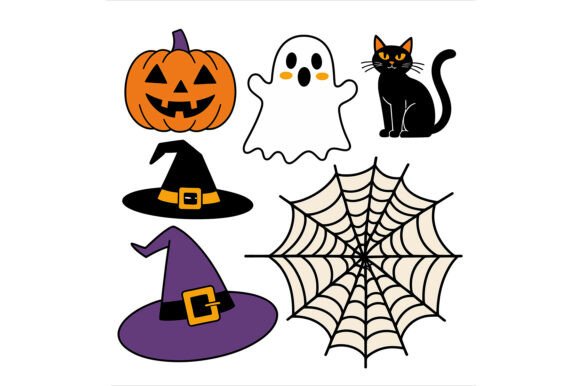
The core value proposition of a high-quality Halloween Elements Set Vector lies in its editability. When a designer acquires an EPS (Encapsulated PostScript) file, they are not merely buying a static image; they are acquiring a malleable component. Every pumpkin, ghost, bat, or cauldron within the set can be deconstructed, recolored, reshaped, and reassembled. This level of control is critical for branding projects where consistency with existing color palettes is non-negotiable. Whether the goal is to create a cohesive line of t-shirts or a sophisticated invitation suite, the ability to manipulate individual elements ensures the final output aligns perfectly with the brand identity.
Understanding the Format: EPS vs. JPEG
A common point of confusion for those evaluating design assets is the inclusion of multiple file formats. The package described typically includes both an EPS vector file and a high-resolution JPEG. Understanding the tradeoffs between these two formats is necessary to determine the best workflow for your specific needs.
The EPS file serves as the master source. It is fully editable in professional vector software such as Adobe Illustrator, CorelDRAW, or Inkscape. Its primary strength is resolution independence. You can scale a tiny icon to the size of a billboard, and the edges will remain crisp. This makes it indispensable for print-on-demand products, large-format posters, and apparel merchandise where physical dimensions vary significantly. However, EPS files require specific software to open and edit, creating a barrier to entry for users who rely solely on basic photo editors or presentation tools.
Conversely, the included JPEG file offers immediate usability. It is a rasterized version of the artwork, ready to be dropped into a document without specialized software. This is ideal for quick-turnaround projects, social media graphics, or digital scrapbooking where the design does not need further modification. The limitation here is fixed resolution; enlarging the JPEG beyond its original dimensions will result in pixelation and blurriness. Therefore, while the JPEG provides convenience, the EPS remains the superior choice for any project requiring long-term flexibility or large-scale printing.
Comparing Vector Sets to Raster Alternatives
When sourcing Halloween graphics, creators often encounter raster-based clipart, stock photography, or AI-generated images saved only as PNGs or JPGs. Comparing the Halloween Elements Set Vector to these alternatives reveals distinct advantages regarding versatility and longevity.
Raster images are excellent for photorealism but struggle with stylized illustrations intended for multi-purpose use. If you purchase a raster image of a haunted house and need to change the roof color to match a client's logo, you are forced to use complex masking techniques that often yield imperfect results. With a vector set, changing the color of the roof is a single-click operation. Furthermore, raster files suffer from compression artifacts over time and across different uses. A vector file maintains its mathematical integrity indefinitely.
Another alternative is generating custom art using AI tools directly. While AI has revolutionized concept generation, the raw output is almost always raster-based. To achieve the same level of editability found in a dedicated vector set, the user must undergo a manual tracing process or use automated vectorization tools, which frequently produce messy paths and excessive anchor points. The Halloween Elements Set Vector described here addresses this by offering AI-concepted designs that have been fully vectorized, resized, and manually edited. This hybrid approach combines the creativity of generative AI with the technical precision required for professional production, saving hours of cleanup work.
Evaluating Use Cases and Project Fit
Determining whether this specific asset set is the right choice depends heavily on the nature of the project. There are scenarios where the investment in a vector set is highly justified, and others where simpler alternatives may suffice.
Print-on-Demand and Apparel: For designers selling on platforms like Redbubble, Etsy, or Printful, the Halloween Elements Set Vector is arguably the optimal choice. These platforms require high-resolution uploads to ensure print quality on diverse materials ranging from cotton tees to ceramic mugs. The ability to resize elements without quality loss ensures that a design looks sharp on a small coaster and a large banner. Additionally, the ability to separate layers allows for creating variations of a design quickly, such as swapping colors for different seasons or product lines.
Branding and Logos: Businesses seeking to incorporate seasonal themes into their marketing often require vector assets to maintain brand guidelines. A logo featuring a Halloween motif must be scalable for business cards, website headers, and vehicle wraps. The clean paths and editable attributes of the EPS file facilitate this adaptability, ensuring the brand remains recognizable regardless of the medium.
Digital Scrapbooking and Personal Projects: For hobbyists engaged in digital scrapbooking or creating invitations, the included JPEG might be sufficient if the output is strictly digital or printed at standard home sizes. However, even in these contexts, having the vector option provides peace of mind. If a project evolves—say, turning a simple card into a poster—the vector file ensures the transition is seamless.
Limitations and Decision Factors
Despite its strengths, the Halloween Elements Set Vector is not a universal solution. The primary limitation is the learning curve associated with vector software. Users unfamiliar with tools like Adobe Illustrator may find the interface intimidating. If a project requires a simple background image for a blog post and the user lacks the skills to manipulate vectors, the EPS file may sit unused, rendering the extra cost less valuable than a simple stock photo.
Furthermore, while the description notes that the design is an original illustration created with AI assistance and then refined, users should verify the license terms regarding commercial use. Although the prompt indicates suitability for logos and merchandise, specific licensing agreements can vary. It is crucial to confirm that the "original illustration" status grants full commercial rights without attribution requirements, especially for branding elements.
Finally, consider the stylistic fit. Vector sets often adhere to a specific aesthetic—flat design, line art, or bold coloring. If a project demands a gritty, textured, or hyper-realistic look that cannot be achieved through simple color changes, a photographic asset or a more complex mixed-media illustration might be a better fit. The vector set excels in clean, graphic styles but may lack the organic texture of hand-painted art unless those textures are explicitly included as editable patterns.
Strategic Integration into Workflows
To maximize the value of the Halloween Elements Set Vector, integrating it into a structured workflow is recommended. Start by importing the EPS file into your vector editor. Before applying global changes, audit the layers to understand how the components are grouped. This step prevents accidental distortion of elements during resizing.
For print projects, convert text elements to outlines before sending files to the printer to avoid font substitution issues. Utilize the vector nature to create gradients and transparency effects that would be difficult to achieve in a raster environment. If the project involves multiple deliverables, save versions of the file in different states—one for print, one for web optimization, and one for archival purposes.
Ultimately, the decision to utilize a Halloween Elements Set Vector rests on the balance between immediate convenience and long-term flexibility. For the adult creator aged 20–50, who likely manages multiple projects with varying requirements, the ability to future-proof a design asset is a significant advantage. While the initial setup requires more technical knowledge than dropping in a JPEG, the capacity to adapt, scale, and refine the artwork ensures that the resource remains useful far beyond a single seasonal campaign. By weighing the technical capabilities against project constraints, designers can confidently select the tools that best serve their creative and commercial goals.